Most gambling problems don’t start with a dramatic moment. There’s no flashing red light. Instead, it usually begins with small shifts, a bit more time spent on pokies, a few more deposits than usual, a quiet tension around money.
If you’ve been wondering how to tell if someone has a gambling problem, you’re not alone. It’s one of the most searched questions around gambling harm in Australia and New Zealand. And the truth is, the warning signs are often behavioural before they’re financial.
This guide breaks down the real signs of problem gambling, what gambling addiction symptoms look like in everyday life, and what you can do next.
The First Big Sign: Loss of Control
The clearest indicator of problem gambling isn’t how much someone loses, it’s whether they can stop.
A person may genuinely intend to spend $50 and walk away. Then it becomes $100. Then they’re chasing “just one feature” or “one decent hit.” They promise themselves it’s the last spin, the last session, the last deposit, but it isn’t.
That creeping loss of control is at the heart of gambling addiction symptoms. It often shows up as irritability when they can’t gamble, restlessness during a break, or constantly thinking about the next opportunity to play.
If gambling shifts from entertainment to something they feel driven to do, that’s a serious gambling harm warning sign.
Lying About Losses (One of the Strongest Warning Signs)
One of the clearest and most confronting signs of problem gambling is dishonesty about losses.
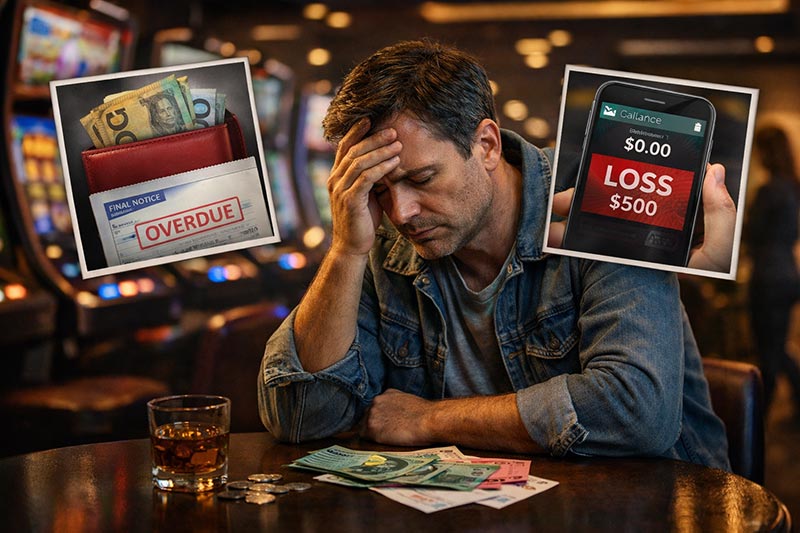
It often starts small. Someone says they only lost $50 when it was actually $200. Or they say they “broke even” when they’re clearly withdrawing money from savings the next day. They might conveniently forget to mention a second deposit, or round numbers down to make the loss sound less serious.
Over time, this minimising becomes a pattern.
They may downplay how often they gamble, hide exact amounts, claim a win that doesn’t match their bank balance, or blame “bad luck” without acknowledging repeated losses.
Why does this happen? Shame.
Lying about gambling losses isn’t usually about being manipulative. It’s often about protecting themselves from judgement, and protecting access to continue gambling. If a partner or family member knew the real number, restrictions might follow. So the truth gets softened.
But here’s the key difference between casual gambling and gambling addiction symptoms: people without a problem don’t need to lie about their losses. They might be annoyed or embarrassed, but they can be honest.
If someone repeatedly hides, minimises, or lies about how much they’ve lost, that’s not a small red flag. It’s a major one.
The Money Starts Acting Strange
Financial changes are often the first visible crack in the wall.
You might notice they’re short on cash more often than before. Bills get paid late. There’s always a reason they need to borrow a small amount “until next week.” Sometimes items quietly disappear, sold, returned, or pawned.
One of the most common signs of problem gambling is chasing losses. Instead of accepting a losing session, they believe they can win it back. It sounds logical in the moment. “I’m due.” “I nearly had it.” “I just need one decent bonus.” But chasing is where manageable losses turn into financial stress.
If someone starts seeing gambling as a way to fix money problems rather than something that costs money, the risk level has shifted.
Secrecy Creeps In
Gambling itself isn’t necessarily secretive. But gambling problems almost always are.
When someone begins hiding bank statements, clearing transaction notifications, switching screens quickly, or becoming defensive over simple financial questions, secrecy has likely entered the picture.
Conversations about money suddenly feel tense. The topic of pokies or betting gets brushed off or redirected. You may feel like you’re only getting half the story.
This secrecy doesn’t mean they’re a bad person. More often, it means they’re stuck between wanting to stop and not being able to. But ongoing secrecy is one of the clearest pokie addiction signs to watch for.
Mood Swings Linked to Wins and Losses
Gambling doesn’t just affect finances, it affects emotions.
You might notice their mood closely tracks their gambling results. After a win, they’re energised, optimistic, even euphoric. After a loss, they’re withdrawn, irritable, or flat. The emotional swings can be subtle at first, but over time they become predictable.
Some people use pokies or online gambling as an escape from stress, boredom, or anxiety. The repetitive, fast nature of modern games makes it easy to zone out. But when gambling becomes the main coping mechanism, it starts replacing healthier outlets.
If someone seems mentally elsewhere, distracted, preoccupied, or constantly thinking about gambling, that’s another strong sign.
Life Gets Smaller
One of the most overlooked gambling addiction symptoms is how life gradually narrows.
Hobbies drop away. Social plans get cancelled. Work performance dips. Sleep patterns shift, especially if online gambling is happening late at night. There’s less presence in family conversations. Less engagement in normal routines.
Gambling doesn’t have to be happening every day for this to occur. It’s the priority shift that matters. When gambling starts taking mental space away from everything else, that’s when concern becomes valid.
How to Approach the Conversation
If you’re trying to figure out how to tell if someone has a gambling problem, you probably care about them. That’s important.
Confrontation rarely works well, especially right after a loss. A calmer approach is usually more effective. Speak about what you’ve observed rather than labelling them. For example, “I’ve noticed you seem stressed after gambling lately,” instead of “You have a problem.”
If dishonesty has occurred, focus on the pattern rather than attacking the lie. “I’ve noticed the numbers don’t quite match up, and I’m worried,” opens the door far better than “You’re lying.”
The goal isn’t to accuse. It’s to create a space where honesty feels safer than hiding.
If you do need to find support for a friend or loved one here are some helplines.
Australia – Gambling Help Online
New Zealand – Gambling Helpline
Final Thoughts
Not everyone who gambles has a gambling problem. Most people play within limits and treat it as entertainment.
But if gambling becomes secretive, financially stressful, emotionally intense, and difficult to stop, especially if someone is lying about how much they’ve lost, those are real signs of problem gambling.
Patterns matter more than one bad night. And if this article made you think of someone, or yourself, that awareness is a strong first step.